
You are running late for the school drop-off and pushing through heavy morning fog across the Penrith region. The car in front suddenly slams on its brakes and your foot instinctively hits the pedal. That split-second feeling of the chassis sliding under ABS modulation – even just an inch – is enough to spike your heart rate.
Has this ever happened to you?
At Angus Car Service, we see how heavily modern vehicles rely on advanced safety systems. The hard truth remains that all that expensive technology turns useless the second your tyres are too bald to physically grip the wet road surface.
Our family-run workshop has been running diagnostics on local cars since 1988.
Before you load the kids into the back seat this winter, checking your tread blocks is the most effective seasonal safety check you can do.
Why Cold Roads and Water Demand Deeper Treads
Standard synthetic rubber actually gets quite hard when the temperature drops below 7°C, which drastically reduces your tyre’s ability to grip the bitumen. When heavy rain hits a cold road, a physical wedge of water builds up right in front of your rolling wheels.
Healthy tyres in winter are designed to disperse large volumes of water through deep tread grooves to maintain road contact.
The real trouble starts once your tread wears down below the 3mm mark, as that water dispersal performance reduces significantly. Tyre mechanics set 3mm as the hard safety limit for wet conditions because the water channels physically stop working past this point.
While the absolute legal limit in Australia sits at 1.5 mm across the main grooves, or once the tread depth is generally the same height as the factory wear indicators.Waiting for your rubber to hit this bare minimum puts your car at severe risk of hydroplaning.
When you hit a puddle with low tread, the rubber lifts off the tarmac and rides on top of the water instead of gripping the road surface, instantly stripping away your steering and braking control.
It is easy to trust advanced safety systems like Electronic Brake Force Distribution (EBD) and traction control, but those computers rely entirely on the physical grip of your tyres to stop a slide.
You also want to check the four-digit manufacturing date code stamped on the sidewall. Rubber naturally degrades and cracks after five to ten years, regardless of how much tread you still have left.
Pairing a safe 3mm tread depth with the correct tyre pressure, which you can usually find printed on your driver’s door jamb, provides the exact footprint required to keep your car tracking safely through wet winter conditions.
Spotting the Warning Signs Before the Rain Hits
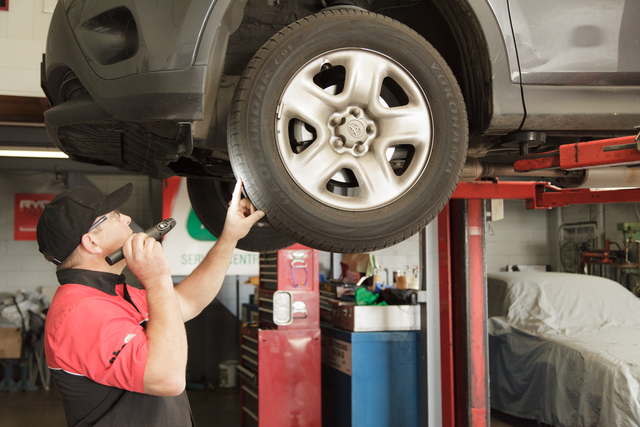
To prevent an emergency before you hit the highway on a wet morning, checking your tread depth needs to become a monthly habit.
Watch for these warning signs that it may be time to change your tyres in Jamisontown.
- Your car slips in wet conditions or loses traction easily while accelerating.
- Steering inputs feel vague or less responsive when turning sharp corners in heavy weather.
- Braking distances extend noticeably longer than they were a few months ago under normal pedal pressure.
- Uneven tread wear shows up on the outer or inner shoulder blocks of the tyre to indicate a bad camber or toe alignment.
- Frequent air pressure loss happens due to a slow bead leak or a hidden puncture that requires constant top-ups.
- The rubber wears down flush with the built-in Tread Wear Indicators (TWIs) sitting inside the central grooves.
When you glance out the window on a dark, rainy morning, are you absolutely confident your car will stop in an emergency? Or are you just crossing your fingers before braving the wet streets of Penrith?
Ignoring your tyre tread depth is a gamble you simply do not have to take. At Angus Car Service, we pride ourselves on being an award-winning workshop that ditches the intimidating mechanic stereotypes, ensuring everyone, especially ourwomen drivers, feels comfortable, respected and heard.
We believe vehicle safety should feel approachable, transparent and stress-free for every driver. Every time you book a service with us, we give back by planting a tree and giving 5 days of education to a child in need on your behalf.
Book your winter tyre inspection with Angus Car Service and make sure your car is ready for safer driving in wet winter conditions.
FAQS
Q: Do you need winter tyres in Australia?
A: Most parts of Australia experience mild winters, meaning standard all-season tyres are perfectly fine for year-round driving. However, if you are heading into alpine regions where temperatures consistently drop below 7°C and roads are covered in ice or snow, fitting specialised winter tyres is highly recommended for your safety.
Q: What is the 3% tyre rule?
A: This rule states that when you replace your old tyres with a different size, the overall diameter of the new tyres must not differ by more than 3% from the manufacturer’s original specifications. Staying within this limit makes certain your speedometer remains accurate and prevents your car’s modern safety systems from malfunctioning.
Q: How many kilometres do tyres last in Australia?
A: There is no set expiry date, but tyres generally last for approximately 40,000 kilometres under normal driving conditions. If you regularly drive on well-maintained roads and avoid carrying heavy loads, your tyres will last longer, though you must still replace them if the rubber degrades or the tread wears thin.